Choosing the best China Insulation Tube Foam supplier requires more than comparing prices or catalog images. Product quality affects energy loss, condensation control, installation time, and service life. The UNEP Global Status Report for Buildings and Construction 2023 reported that buildings consumed about 34% of global energy and produced approximately 37% of energy-related carbon emissions in 2022. These figures explain why reliable pipe insulation has become a practical purchasing priority, not merely a construction detail.
A qualified supplier should provide verified thermal conductivity, water absorption, density, temperature range, fire-performance data, and dimensional tolerances. Closed-cell PE foam, rubber foam, and other materials behave differently around chilled water, hot-water, HVAC, and industrial lines. The U.S. Department of Energy also notes that insulating hot-water pipes can reduce heat loss and shorten waiting times at outlets. Small details matter. Ask for test reports, production samples, factory audit records, and batch traceability. ISO 9001 certification can support process confidence, but it does not replace independent product testing.
This guide examines China-based suppliers through technical capability, manufacturing experience, customization, export support, and documented compliance. Reports from organizations such as ASHRAE and the International Energy Agency provide useful performance context, yet supplier claims still require careful verification. There is no universal “best” manufacturer. A low quotation may hide inconsistent thickness, weak adhesive, or poor packaging. That deserves attention. Buyers should compare actual samples under project conditions and confirm applicable standards before signing contracts. The strongest supplier is usually the one that communicates clearly, tests consistently, and accepts responsibility after delivery—not simply the one with the largest online catalog.
China Best Insulation Tube Foam Suppliers?
Insulation tube foam is a flexible sleeve fitted around pipes, cables, or small ducts. It is commonly made from closed-cell polyethylene, rubber, or similar polymer foam. Tiny sealed cells slow heat movement. That simple structure also limits moisture absorption.
The foam works by trapping still air around the pipe. In winter, it reduces heat loss from hot-water lines. In summer, it helps keep chilled pipes cold and reduces condensation. A cold pipe without insulation may develop droplets, especially in humid rooms. Those droplets can stain ceilings, damage fittings, or encourage surface mold.
Good installation matters as much as foam quality. The sleeve should fit closely, with seams sealed using compatible adhesive or tape. Gaps around valves often become weak points. They are easy to miss. A practical supplier should provide density, thermal conductivity, temperature range, and fire-performance data. Material thickness alone is not enough.
I have seen installers choose thick foam for every project, but that approach can waste space and money. Pipe temperature, indoor humidity, exposure, and local safety requirements should guide the choice. Foam can also age, compress, or crack under sunlight and heat. Regular inspection is sensible, although it is sometimes neglected. Supplier reliability depends on consistent dimensions, clear test documents, and honest technical support rather than attractive packaging.
Insulation tube foam is a prefabricated sleeve placed around pipes to reduce heat transfer, condensation, freezing risk, and energy loss. Its closed-cell or fibrous structure traps air, creating a barrier against conduction and convection. Lower thermal conductivity indicates better insulation performance.
Typical thermal conductivity values at approximately 20–25°C. Actual performance varies with density, moisture, temperature, thickness, and manufacturing process.
Choosing China’s best foam insulation tube supplier requires more than comparing prices. The foam material affects thermal stability, flexibility, and service life. Common options include polyethylene, elastomeric rubber, and polyurethane. Polyethylene tubes are lightweight and resist moisture. Elastomeric foam bends well around tight pipe corners. Polyurethane can offer strong insulation, but it may need protective facing in demanding environments.
Thermal conductivity is a key performance value. Lower conductivity usually means better insulation, but test conditions matter. Ask for results at a stated temperature, humidity, and thickness. Density, water absorption, dimensional stability, and compression resistance also deserve attention. A tube that collapses under a clamp may lose its insulating effect. That detail is easy to miss. Fire performance must match the installation environment and local building requirements. Request complete test reports, not only a product datasheet. Relevant standards may include ASTM, EN, or applicable national requirements, depending on the destination market.
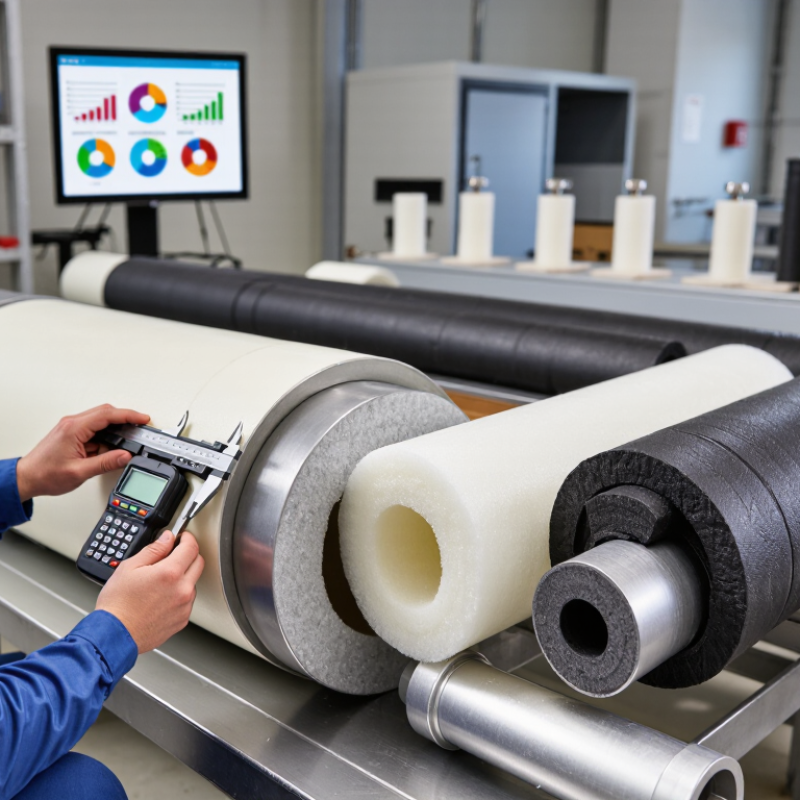
During supplier evaluation, inspect sample cuts for uniform cells, smooth inner walls, and consistent thickness. Measure the tube after storage and again after installation. A reliable manufacturer should explain raw material control, extrusion accuracy, aging tests, and batch traceability. In practice, a low lambda value alone can mislead buyers. I have seen attractive samples fail after heat exposure or compression. Supplier claims still need verification. Independent testing is worthwhile for large projects, especially when pipes face temperature changes, condensation, or outdoor handling.
China Best Insulation Tube Foam Suppliers?
How to Evaluate China-Based Insulation Tube Foam Suppliers
Insulation quality affects energy use, condensation control, and maintenance costs. The IEA’s Energy Efficiency 2023 report states that buildings consume about 30% of global final energy. Therefore, supplier evaluation should begin with measurable performance, not attractive photographs.
Request tested thermal conductivity at a stated temperature, not one unexplained figure. Check density, water absorption, dimensional stability, and operating-temperature limits. For flexible foam, ask for fire-test results under the standard required in your market. ISO 5660 and EN 13501-1 may support assessment, but they are not interchangeable. A certificate without a matching product code is a warning sign.
Inspect the factory’s batch records and raw-material controls. Ask for three recent production reports, not only a laboratory sample. Confirm whether the supplier controls cell structure, wall thickness, adhesive compatibility, and cutting accuracy. Small defects matter.
For shipping, compare packed volume, moisture protection, carton strength, and actual lead-time records. The World Bank’s Logistics Performance Index 2023 highlights the importance of customs handling, tracking, and delivery reliability. A low unit price may lose value after damaged cartons or delayed installation.
Independent testing adds confidence. Still, no single certificate settles the question. A polished sample can mislead. I would require pre-shipment inspection and retain samples from every approved batch. Also, verify the supplier’s response when specifications change; flexibility is useful, but uncontrolled changes are risky.
| Evaluation Dimension | Recommended Weight | Reference Data or Target | How to Verify | Evaluation Guidance |
|---|---|---|---|---|
| Material Type | 10% | Elastomeric rubber foam, polyethylene foam, and mineral wool are common insulation options. | Review the technical data sheet, composition statement, and product sample. | Select the material according to temperature, moisture, flexibility, fire, and installation requirements. |
| Thermal Conductivity | 20% | Flexible closed-cell foam commonly falls around 0.034–0.043 W/(m·K), depending on material, temperature, and density. | Request test reports showing the test temperature, method, specimen thickness, and measured value. | Compare results only when test conditions are equivalent; lower conductivity generally indicates better thermal performance. |
| Operating Temperature | 12% | Many flexible foam products are specified approximately from -50°C to +105°C, but the range varies by formulation. | Check the product specification and confirm continuous-use temperature rather than short-term exposure temperature. | The stated range should cover the actual fluid, ambient, and installation temperatures. |
| Water Vapor Resistance | 15% | Closed-cell foam is generally selected for applications requiring low water absorption and high vapor resistance. | Request water absorption and water vapor permeability results using a recognized test method. | For chilled-water and condensation-control applications, inspect both the foam structure and the vapor-barrier performance. |
| Fire Performance | 15% | Fire classifications depend on the market and standard, such as EN 13501-1, ASTM E84, or equivalent requirements. | Verify reports from an independent laboratory and confirm that the tested product matches the supplied construction. | Do not rely only on terms such as “flame retardant”; require a documented classification or tested rating. |
| Dimensional Accuracy | 8% | Common tube-insulation dimensions are specified by inside diameter and wall thickness, with tolerances agreed in the purchase specification. | Measure samples with calibrated tools and compare them with the approved drawing or dimensional table. | Consistent dimensions reduce installation gaps, compression, and material waste. |
| Compression and Recovery | 7% | Flexible foam should retain its shape after handling and installation; acceptable limits must be defined for the application. | Request compression-set or recovery test data and inspect samples after bending and compression. | Poor recovery can create gaps at joints and reduce the designed thermal performance. |
| Production Capacity | 5% | Capacity should be assessed against the required monthly quantity, size range, and delivery schedule. | Request a production-capacity statement, lead-time plan, and evidence of similar-volume orders. | A suitable supplier should demonstrate stable output rather than only offering a low quotation. |
| Quality-Control System | 5% | Key controls include incoming-material inspection, process checks, final inspection, and batch traceability. | Review inspection records, calibration certificates, corrective-action procedures, and sample batch documents. | Prefer suppliers that can provide consistent documentation for every production batch. |
| Packaging and Export Readiness | 3% | Packaging should protect foam tubes from compression, moisture, ultraviolet exposure, and contamination during transport. | Request packaging photographs, carton specifications, pallet details, and shipping documentation samples. | Strong packaging and clear export documentation help reduce damage and customs delays. |
Reference values are general industry guidance and should be confirmed against the applicable product standard, project specification, and independent test results.
Manufacturing capability matters more than catalogue size. Grand View Research estimated the global insulation market at USD 72.41 billion in 2022, with projected growth near 6% annually through 2030. That growth increases pressure on suppliers to deliver stable foam density, accurate wall thickness, and consistent thermal performance. Experienced factories should control extrusion speed, cooling temperature, and cutting tolerances. Ask for production records, not only product photos.
Customization should follow the installation environment. A supplier may adjust inner diameter, wall thickness, length, color, surface texture, and adhesive backing. For chilled-water pipes, closed-cell foam and low water absorption are essential. For hot-water systems, temperature resistance deserves closer review. ISO 8497 and ASTM C177 or C518 can support thermal testing, while flame-performance requirements should match the destination market. Small details matter. A loose fit can create air gaps and condensation.
Quality control must continue after extrusion. Reliable manufacturers test density, dimensional recovery, thermal conductivity, water absorption, and surface defects by batch. They should retain samples and provide traceability from raw material to carton. The International Energy Agency reports that buildings consume around 30% of global final energy, making insulation performance commercially important. Still, a certificate is not proof by itself. I would request an independent test report and inspect samples under real bending conditions. Some suppliers promise perfect uniformity; that claim deserves skepticism. Even good factories can experience variation when tooling changes or recycled content enters the formula.
When comparing Chinese insulation tube foam suppliers, price should not stand alone. A low quotation may exclude molds, packaging, testing, or inland delivery. Request a detailed offer showing foam density, wall thickness, inner diameter, tolerance, and carton quantity. For a common two-meter tube, compare the price per meter, not only the price per carton. Ask whether prices use EXW, FOB, or another trade term. Small wording differences can change the landed cost.
Reliable export service is practical, not decorative. Experienced suppliers should provide product data sheets, sample approval records, commercial invoices, packing lists, and shipment photos. Confirm their ability to handle your destination’s labeling, documentation, and packaging requirements. For sea freight, inspect moisture protection and pallet stability. For urgent orders, ask about production capacity and realistic lead times. A factory that promises everything may deserve closer questions.
Supplier selection needs evidence. Request a recent sample, then measure recovery after compression, surface uniformity, odor, and cutting accuracy. Check quality control procedures, batch traceability, and responses to nonconforming goods. Communication matters too. Can the sales team explain a tolerance clearly? Can they report a delay early? I have seen buyers focus on a perfect sample and ignore inconsistent mass production. That is a costly mistake. Still, inspection cannot replace clear specifications, and careful buyers sometimes underestimate seasonal shipping changes.
It is a flexible sleeve fitted around pipes, cables, or small ducts. Closed cells trap still air and slow heat movement.
It reduces heat loss from hot-water lines. Less heat escapes through the pipe wall and surrounding air.
It helps keep chilled pipes cold and reduces surface condensation. In humid rooms, uninsulated pipes may form droplets that stain ceilings.
Common materials include polyethylene, elastomeric rubber, and polyurethane. Polyethylene resists moisture, while rubber bends well around tight corners.
No. A thick sleeve may waste space and money. Pipe temperature, humidity, exposure, and safety requirements should guide thickness.
Request thermal conductivity, density, water absorption, temperature limits, and compression resistance. Ask for test conditions, not just one attractive number.
Check uniform cells, smooth inner walls, and consistent thickness. Measure the tube after storage and again after installation.
Gaps around valves and poorly sealed seams create weak points. Use compatible tape or adhesive and inspect hidden areas carefully.
Review batch records, raw-material controls, production reports, and delivery history. A polished sample can mislead. I would still request independent testing.
Inspect it periodically for compression, cracks, aging, and sunlight damage. Regular checks are sensible, though they are often neglected.
This guide explains how Insulation Tube Foam helps reduce heat transfer, condensation, noise, and energy loss in piping systems. It introduces common materials such as polyethylene, rubber, and polyurethane, while highlighting important performance factors including thermal conductivity, temperature resistance, flexibility, fire behavior, moisture resistance, and dimensional stability. Understanding these properties allows buyers to match insulation products with plumbing, HVAC, refrigeration, construction, and industrial applications.
The article also presents practical methods for evaluating China-based suppliers, including production capacity, material consistency, mold development, size customization, surface quality, and quality-control procedures. Buyers should review testing documentation, production samples, packaging standards, lead times, export experience, and communication efficiency before making a decision. Pricing should be assessed together with product performance, order volume, tooling costs, shipping arrangements, and after-sales support. A reliable supplier should offer transparent quotations, stable manufacturing, clear inspection processes, and solutions that meet the project’s technical and commercial requirements.

Kingflex